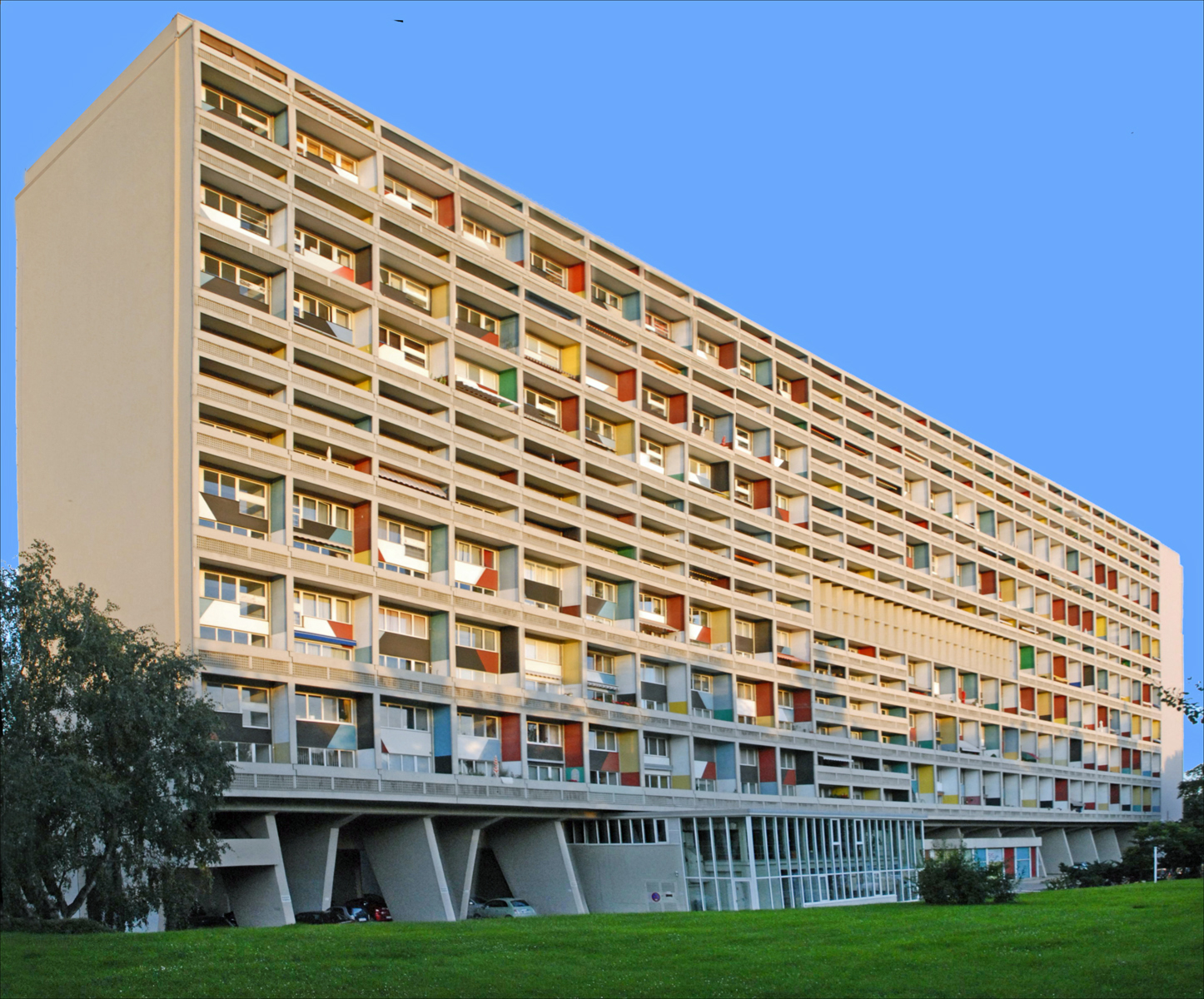
Brutalism did not appear by accident. It did not emerge from a taste for ugliness, nor from a simple fascination with concrete. It came out of a historical fracture. Post-war Europe needed to rebuild cities, institutions, housing, and public life at speed, at scale, and under pressure. In that context, an architecture of polish and illusion began to feel insufficient. Another language stepped forward: harder, clearer, more structural, less willing to hide what a building was made of or how it stood.
That is the true ground of Brutalism. Not a style born from decoration, but a position born from necessity, conviction, and a new demand for truth in form. To understand its origin properly, one has to look beyond the cliché of raw concrete and return to the conditions that produced the movement: reconstruction, modernism, material honesty, and a deep refusal of architectural disguise.
Brutalism Was Born in the Post-War World
The origin of Brutalism belongs to the years following the Second World War. Europe was physically damaged, politically transformed, and socially restructured. Entire urban environments had to be rebuilt. New housing programs, civic institutions, universities, cultural centers, and public infrastructures had to be conceived quickly and decisively.
“In this vein of responding to the post-war logic of a new world and a new philosophy of thought, we saw the emergence of raw materials, of concrete. And some contemporary artists are indeed embracing this absolute minimalism. Almost futuristic. FCK, a.k.a. Frédérick Gautier, greatly impressed me with his ceramic collections.
As did quite a few recent designers who are breaking the mold and attempting to impose a raw, new vision of the things in our daily lives.”
— 0xec6d0
This was not a neutral setting. Architecture had to respond to urgency, scarcity, industrial methods, and a different idea of collective life. Under those conditions, soft decoration and inherited formal gentility began to lose force. A more direct architectural language became possible. One that accepted weight. One that accepted repetition. One that accepted the unfinished authority of matter itself.
Brutalism emerged from that pressure. It was not merely aesthetic. It was historical.
The Link Between Modernism and Brutalism
Brutalism did not come from nowhere. It grew out of modernism, but it did not simply repeat modernist ideals. Modernism had already stripped away much ornament and pushed architecture toward function, clarity, and abstraction. Brutalism inherited part of that discipline, then pushed it into a harsher register.
Where earlier modernist works could still appear smooth, luminous, or refined, Brutalism often thickened the form. It made weight more explicit. It reduced the distance between structure and appearance. It accepted rougher surfaces where roughness carried truth. It was less interested in elegance than in legibility, less interested in grace than in force.
In that sense, Brutalism should be read as both a continuation and a hardening of modernist logic.
Why the Name Matters
The word Brutalism has misled generations of readers and viewers. Many assume the movement must be about aggression because the word sounds violent. That reading is false. The name is tied to the French expression béton brut, meaning raw concrete. The key idea was not brutality in the moral or emotional sense, but rawness in the material and architectural sense.
That distinction is decisive. The origin of Brutalism does not lie in a cult of hardness for its own sake. It lies in a desire to let buildings speak honestly through structure, mass, surface, and construction. The rougher aesthetic followed from that commitment. It was not the starting point. It was the consequence.
The British New Brutalism
Although the larger conditions of Brutalism were international, one of its clearest early formulations took shape in Britain through what became known as the New Brutalism. This was not only a matter of materials or form. It was also a matter of attitude. The New Brutalism called for architecture that would be direct, readable, and stripped of false refinement.
The British context mattered. Post-war reconstruction, welfare-state ambition, and the search for a new civic language created fertile ground for a more rigorous and exposed architecture. Buildings no longer had to perform politeness. They could assert structure, volume, repetition, and public presence with far greater intensity.
The New Brutalism gave the movement one of its sharpest names, but the underlying impulse belonged to a wider transformation in architecture.
The Main Forces Behind the Origin of Brutalism
-
Post-War Reconstruction
After the war, cities needed to be rebuilt rapidly and at scale. Brutalism answered a world that could not afford decorative hesitation. It emerged in a climate that demanded seriousness, utility, and material directness.
-
Material Honesty
One of the movement’s deepest convictions lay in honesty. Materials did not need cosmetic concealment. Concrete could remain concrete. Structure could remain visible. Architecture could stop pretending to be lighter, softer, or more ornamental than it truly was.
-
A Rejection of Decorative Illusion
Brutalism refused surface charm when that charm weakened the truth of the building. Ornament was not attacked in a theatrical way; it was sidelined because it no longer felt necessary. Form, mass, rhythm, and construction carried enough force on their own.
-
Industrial and Social Change
The post-war world was shaped by new production methods, new institutions, and new social expectations. Brutalism belonged to that shift. It fit a world of collective infrastructures, public programs, educational buildings, civic complexes, and large-scale urban visions.
-
A Search for Legibility
Brutalism made buildings easier to read in one crucial sense: one could feel how they stood, how they were assembled, how their masses related, how their repetition generated force. That legibility became central to the movement’s identity.
Brutalism Was Never Just About Concrete
Concrete became the movement’s most famous signature, but its origin cannot be reduced to one material. The deeper origin of Brutalism lies in a discipline of exposure. Exposed structure. Exposed material. Exposed mass. Exposed construction. Concrete happened to serve that discipline with unusual intensity, which is why it became so closely associated with the movement.
But the essence of Brutalism is not simply concrete poured at scale. It is the refusal to disguise the building’s reality. That is why a structure can use concrete without being Brutalist, and why Brutalism must be understood through principles rather than appearances alone.
Why Brutalism Took Hold
Brutalism took hold because it matched its time. It belonged to an era that demanded new institutions and new forms of collective seriousness. It offered an architecture that could carry public weight. Housing complexes, universities, churches, civic centers, libraries, and administrative buildings all became terrains where this language could expand.
Its visual force also gave it unusual symbolic power. Brutalist buildings do not disappear into the city. They insist. They occupy. They state. For supporters, that made them honest and memorable. For critics, oppressive and cold. But whether loved or rejected, they were rarely neutral. That, too, explains why the movement spread so widely and remains so disputed.
Common Mistakes About the Origin of Brutalism
-
Brutalism began as a concrete trend
No. Concrete mattered, but the movement began as a broader search for truth in structure, material, and form.
-
Brutalism came from a taste for harshness
No. Its harsher surfaces followed from honesty and legibility, not from a desire to shock for its own sake.
-
Brutalism was detached from history
No. The movement is inseparable from post-war reconstruction, social change, and the architectural consequences of that era.
What to Remember
The origin of Brutalism lies in the post-war world: in reconstruction, urgency, industrial logic, and a refusal of decorative falsehood. It developed out of modernism, yet sharpened modernism into something denser, rougher, and more confrontational. Its name points toward rawness, not brutality. Its ambition was never to flatter the eye, but to make architecture more truthful, more legible, and more materially present.
To understand where Brutalism came from is to understand that it was never just a style. It was a historical response. A hard answer to a broken world. And from that fracture, it built one of the most forceful architectural languages of the twentieth century.
Suggested internal links
Leave a Reply